
Kerala wedding traditions · Hindu
Kerala Hindu wedding
 By Anandu G Prakash, co-founder and lead photographer · Updated Thursday 19 November 2026
A Kerala Hindu wedding centres on the thalikettu: at the muhurtham, an auspicious time fixed from the couple’s horoscopes, the groom ties the thali on the bride. The ceremony is short, often 5 to 15 minutes. Then come the saree from the groom, the garlands, the sadhya feast and the bride’s entryinto her new home with a lit lamp.
This is the deep dive from our guide to Kerala wedding traditions. We’ve photographed 200+ weddings since 2017, and Anandu has shot more than 1,000 on his own. We know exactly how fast the thali goes on, and exactly how fast the guests leave for lunch afterwards.
Kerala Hindu weddings at a glance, community by community
Every Kerala Hindu wedding has a thali and a muhurtham. Almost everything around them changes by community, by region and by family, which is why two cousins can attend the same wedding and describe two different ceremonies at dinner.
| Community | What stands out | Worth knowing |
|---|---|---|
| Nair | A short ceremony, often about 15 minutes, then the pudava from the groom | The bride’s maternal uncle often has a central role |
| Namboothiri | Vedic rites around the sacred fire; the bride’s father ties the thali | Once four days, now often three or four hours |
| Ezhava and Thiyya | Simple ceremonies, shaped by Sree Narayana Guru’s reforms | Customs differ by region and family |
| Tamil Brahmin (Iyer) | Kasi yatra, the oonjal swing, the bride seated on her father’s lap | The groom’s sister ties the remaining knots of the thali |
| Vishwakarma | A thali shaped like a shivling | Little is written down, so ask the family |
The Kerala Hindu wedding day, step by step
Photographers quoted in Scroll.in put a Kerala Hindu ceremony at 5 to 15 minutes. That’s less time than it takes to park at the hall, walk in, realise the gift envelope is still in the car, walk back for it, and return to find everyone already queueing for the sadhya.
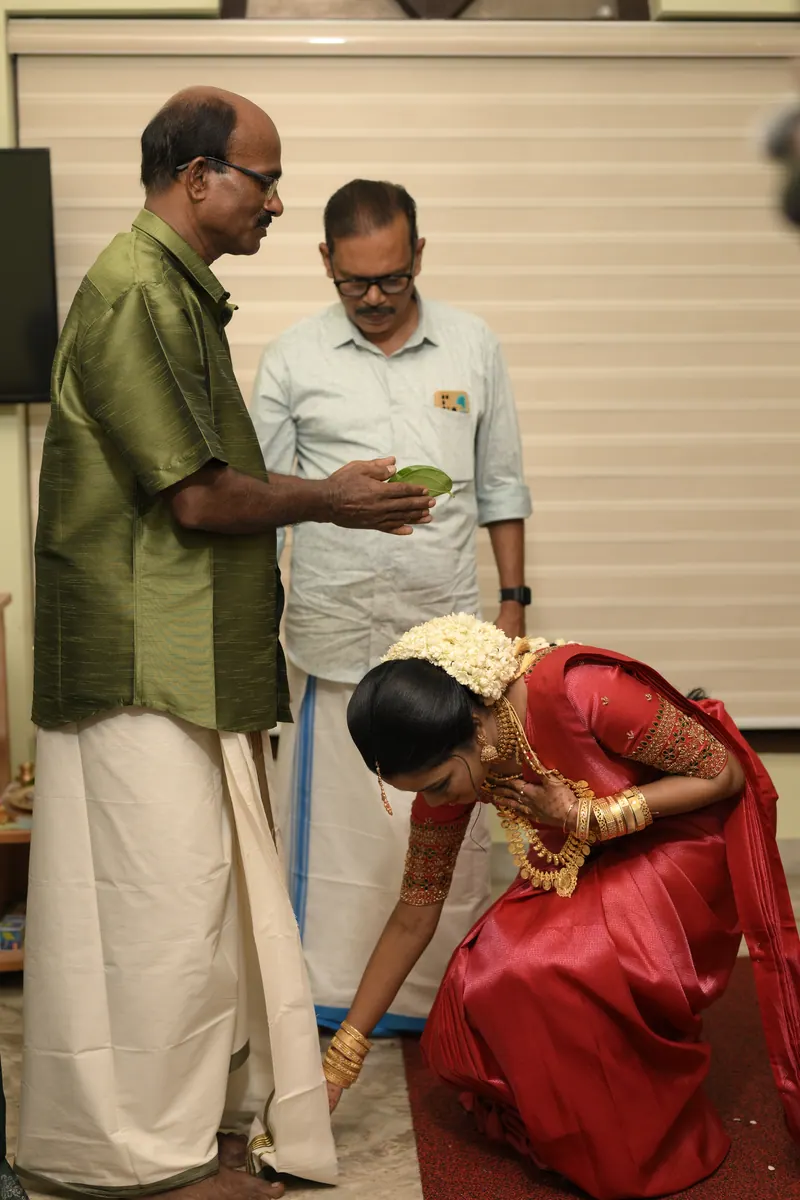
- Blessings at home. Before leaving for the venue, the bride and groom touch the elders’ feet and take their blessing, the dakshina (WeddingSutra).
- The groom’s welcome. Women of the bride’s family greet him with the nilavilakku and a thalam, a plate of flowers and a small lamp, and her younger brother washes his feet (WeddingBazaar).
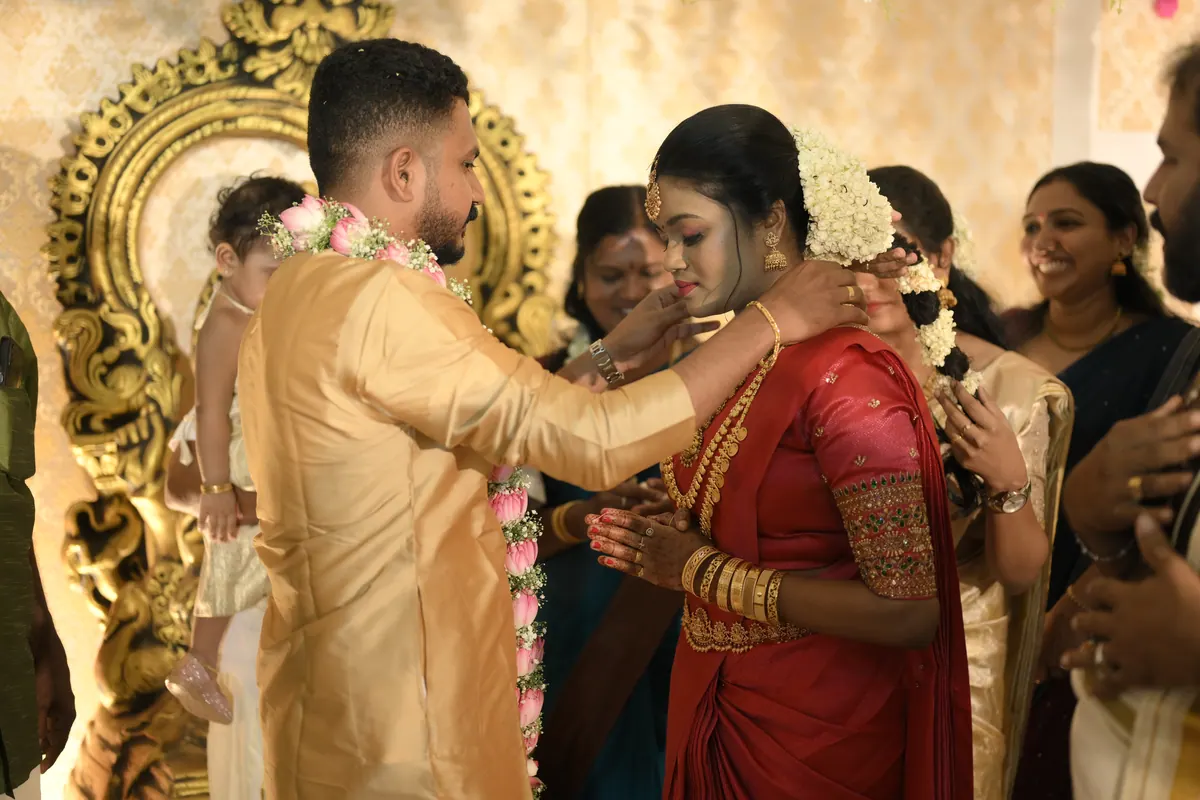
- The thalikettu. At the muhurtham, to the kettimelam drums and the women’s vaikurava, the groom ties the thali.
- The pudava and kanyadanam. The groom gives the bride a saree, and her father places her hand in the groom’s. Families disagree on which comes first, and every family is sure it’s theirs.
- Garlands and rounds. The couple swaps garlands and walks round the lamp or the sacred fire, three times in most accounts (WeddingWire).
- The sadhya, then the new home. Lunch on a banana leaf, then the bride enters the groom’s house carrying a lit lamp.
Before the wedding: horoscopes, nischayam and haldi
Most Kerala Hindu matches start with the horoscopes. The astrologer checks ten poruthams, Rajju is treated as essential, and five or six matching is the common guideline (Hindutone), which is a gentler pass mark than most Kerala parents ever accepted on a report card.
Then comes the nischayam, the engagement, where the families fix the muhurtham and the couple usually swaps rings, the mothiram maattal (WeddingSutra). In some Nair families the groom’s sister brings the bride’s saree the evening before (Wedding Affair), and she’s usually the most organised person in the house that night.
The newest addition is the haldi. A 2020 Deccan Herald feature put it plainly: “the mehendi is now as important as the muhurtham.” Not everyone agrees it belongs, but the turmeric has made itself at home anyway. As we once wrote on Instagram: “Who needs a spa day when your friends happily attack you with turmeric?”
The thalikettu: two minutes that matter
At Guruvayur the thali rite takes about two minutes, according to The News Minute. Two minutes is shorter than the photo queue for the stage, shorter than the walk to the sadhya hall, and shorter than the argument afterwards about who was standing in front of the photographer.
The thali itself changes by community. Many Nair brides wear a leaf-shaped pendant with Krishna on it, the aalila thali (EdTimes), and the Vishwakarma thali is shaped like a shivling (INTACH).
Temple weddings move fastest. Guruvayur held 416 weddings between 4.10am and 12.45pm on one Sunday in August 2026 (Onmanorama), then beat it three weeks later with 420 (Kerala Kaumudi). Our Guruvayur temple wedding guide covers booking, tokens and the rules.
How each community does it differently
Ask three families how a Kerala Hindu wedding runs and you’ll get four answers, plus a fifth from whoever’s holding the camera. Here’s what the sources agree on.
Nair weddings
Nair weddings “don’t usually last longer than 15 minutes,” and the bride’s uncle often leads, a leftover of the old matrilineal system (EdTimes). Fifteen minutes, start to finish, is about as long as the bride’s touch-up between photos. After the thali comes the pudamuri, the groom’s gift of a saree (WeddingSutra).
Namboothiri weddings
The longest ceremony in the state. It was a four-day affair, now “shortened to 3 or 4 hours” (namboothiri.com), with Vedic rites around the fire and the bride’s father tying the thali (eSamskriti). Bring water and patience. Mostly patience.
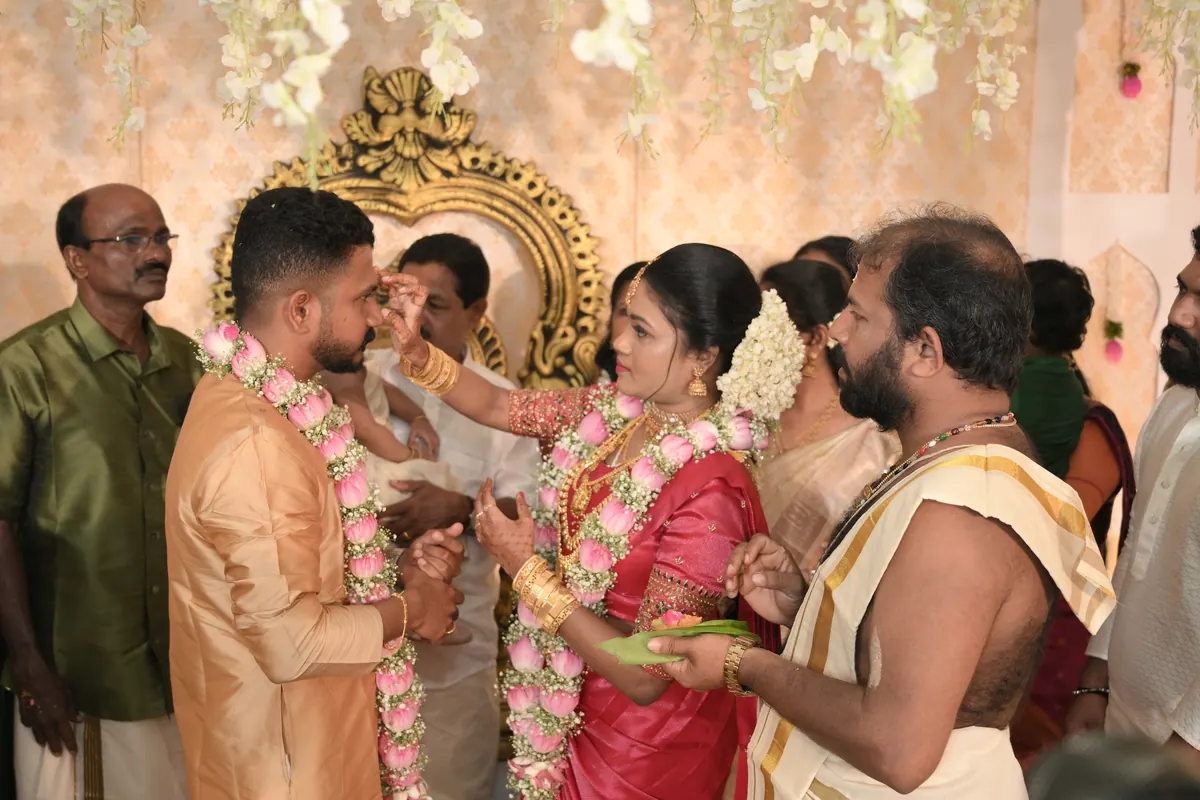
Ezhava and Thiyya weddings
At a 1904 meeting in Paravur, Sree Narayana Guru pushed for a simpler marriage system (Kerala Tourism). Many families still keep it short, though customs differ by region, and the best guide is the oldest aunt in the room.
Tamil Brahmin (Iyer) weddings
Common in Palakkad and Thrissur, these run up to two days, with the kasi yatra, the oonjal swing and the bride on her father’s lap. The groom ties the first knot of the thali and his sister ties the other two (eSamskriti), so the most important knot of the day has a co-author.
Kerala Hindu wedding dress code: bride, groom, cousins and guests
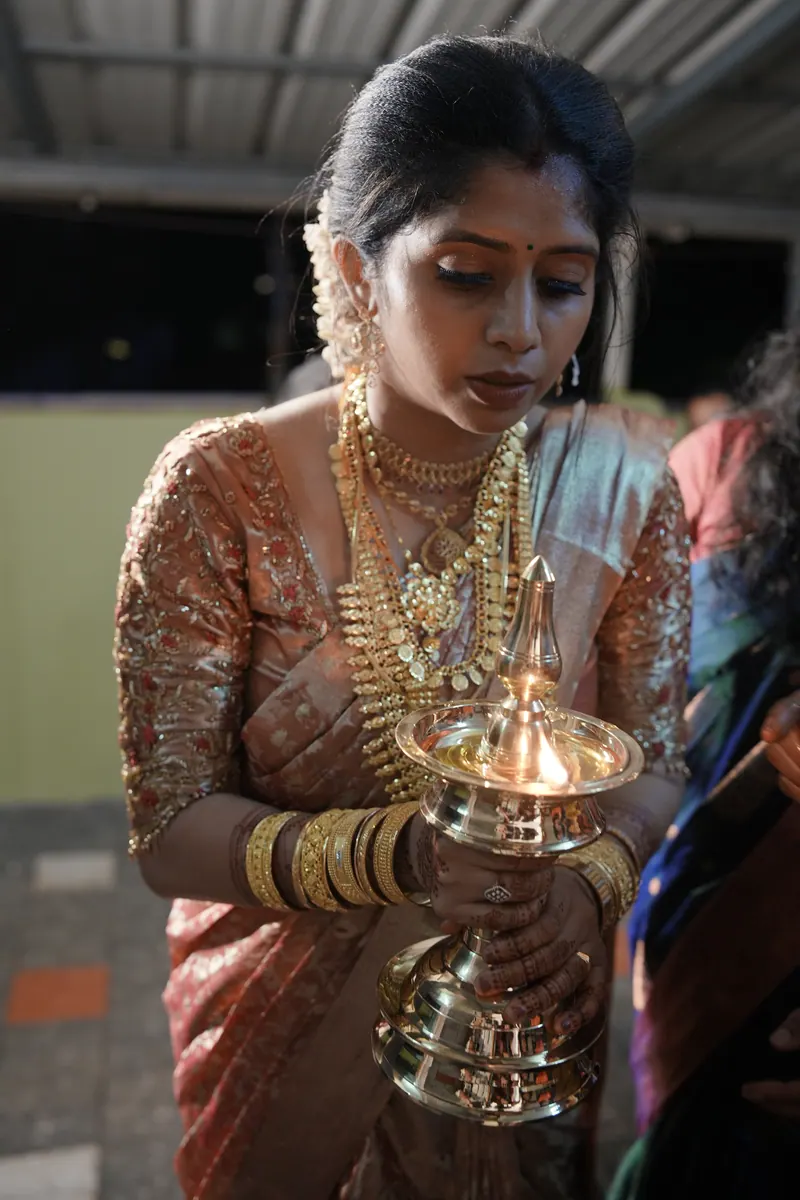
Brides now lean towards silk kasavu, and red and green versions are popular (WeddingWire). Then come the jewels: the mulla mottu mala, named for jasmine buds, the palakka mala and the nagapadam, which “resembles the hood of a snake” (Kalyan Jewellers).
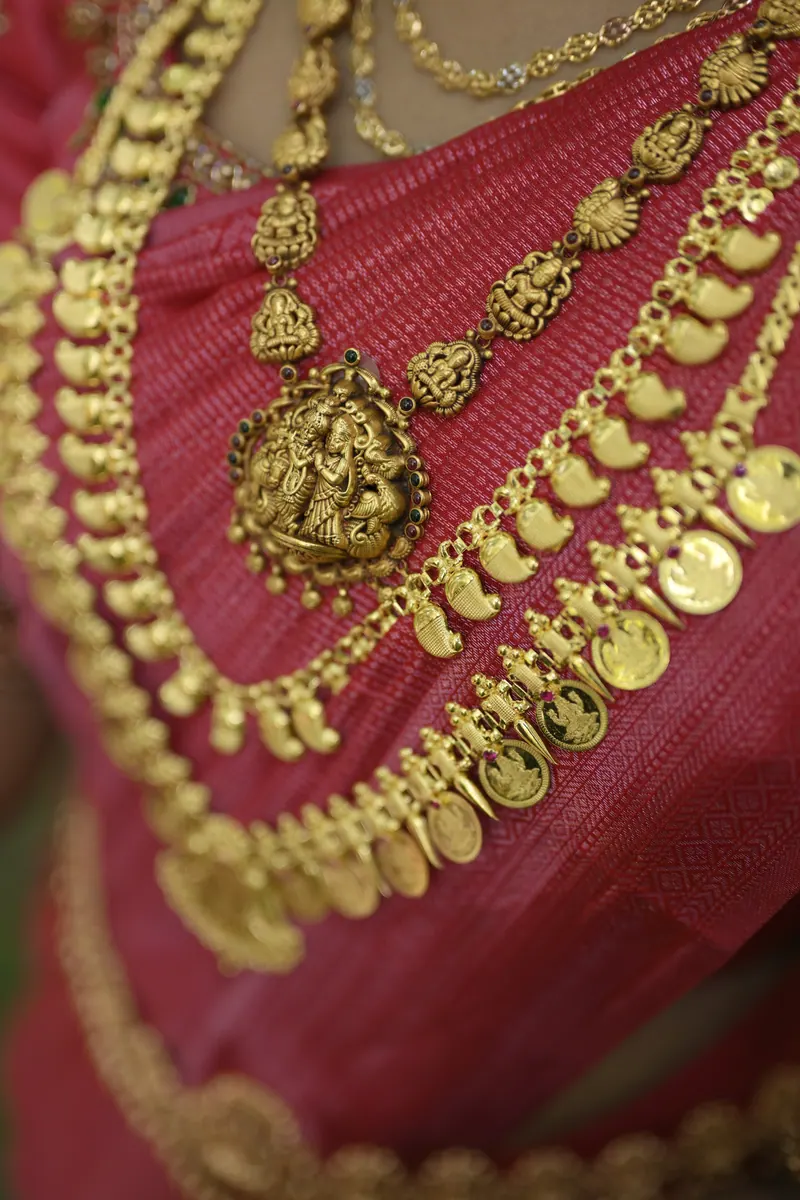
Reuters reported in 2015 that Kerala weddings use up to 400 grams of gold each. The bride wears most of it at once, which is why she walks onto the mandapam slowly: half of that is grace, and half is physics.
| Who | Usually wears | Worth knowing |
|---|---|---|
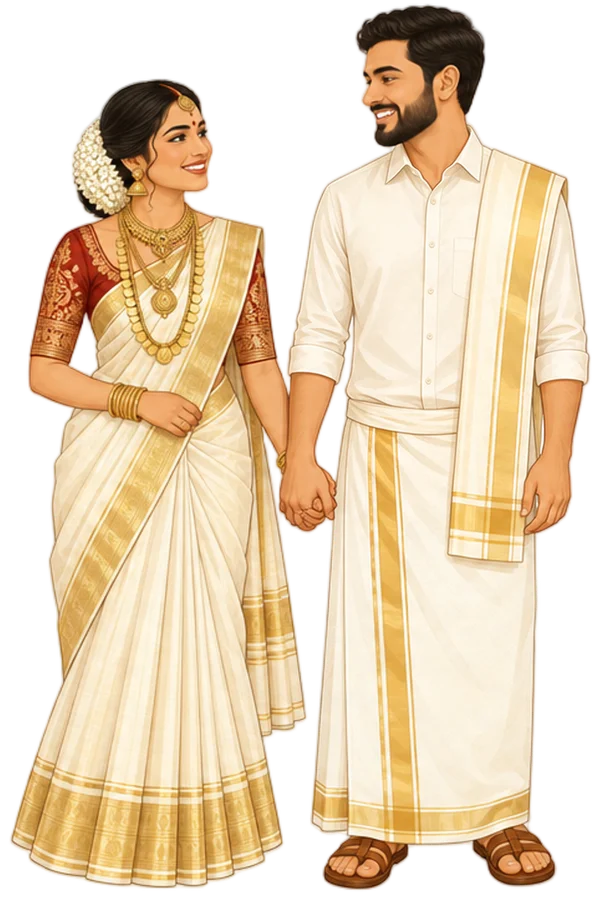
| Bride | Kasavu or silk saree, temple jewellery, jasmine in the hair | Often changes outfit for the reception |
| Groom | Kasavu mundu with a shirt or silk kurta, and an angavastram | Temples may ask men to go without a shirt |
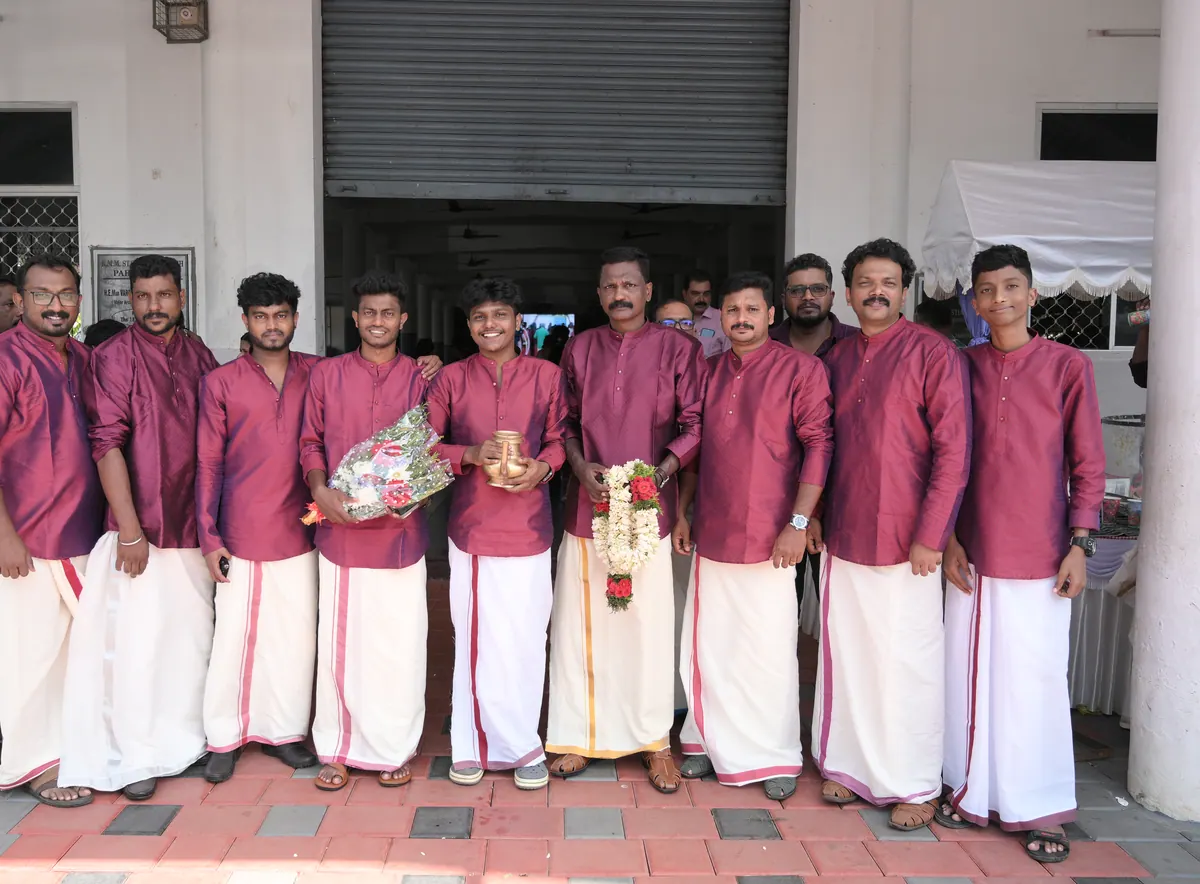
| Women cousins | Kasavu with a coordinated blouse, or silk in a shared colour | Agree the colours early |
| Men cousins | Matching kurta and mundu, or shirt and mundu | Never fold the mundu above the knee on stage |
| Guests | Women: saree or churidar. Men: shirt and mundu, or formal wear | Skip jeans, especially at a temple |
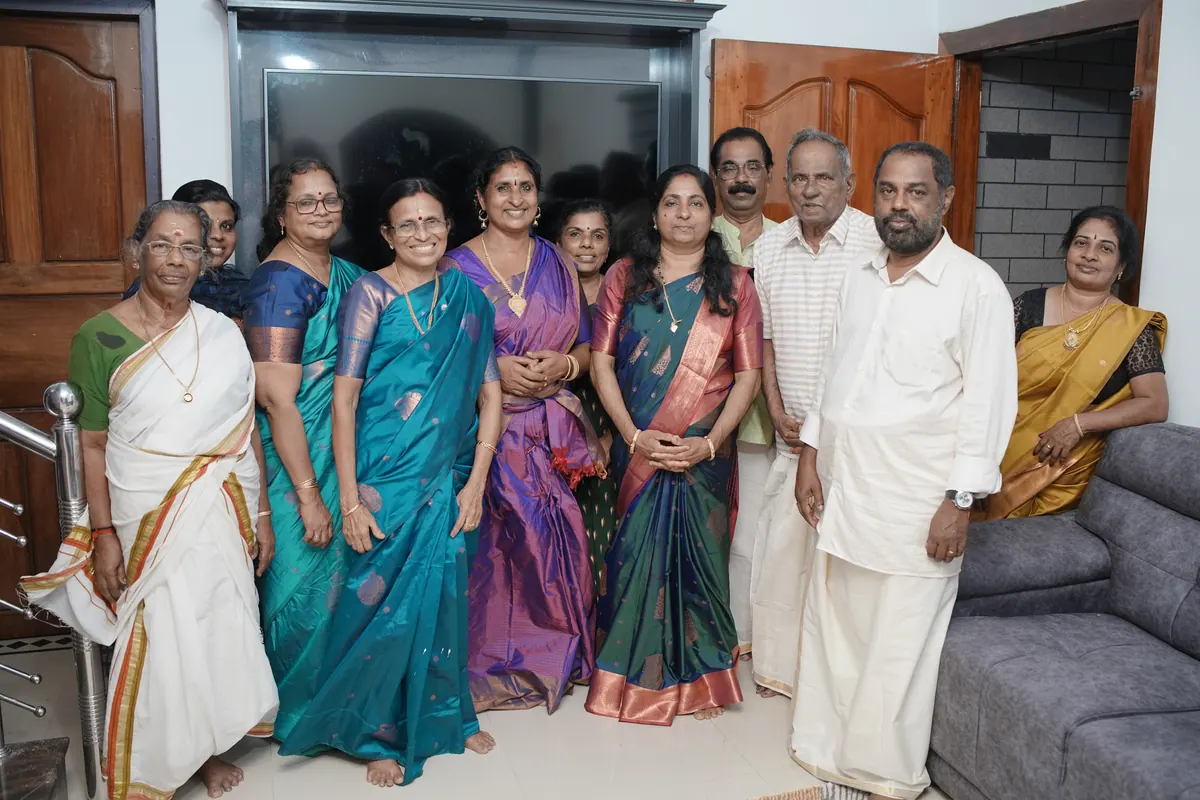
What cousins wear
Cousins often double as bridesmaids now, with colours planned in advance (Deccan Chronicle). For the women, WeddingWire suggests kasavu with a minimal gold border and matching blouses (WeddingWire), and a shared palette in different shades works just as well, as long as nobody quietly switches to a brighter pink on the morning.
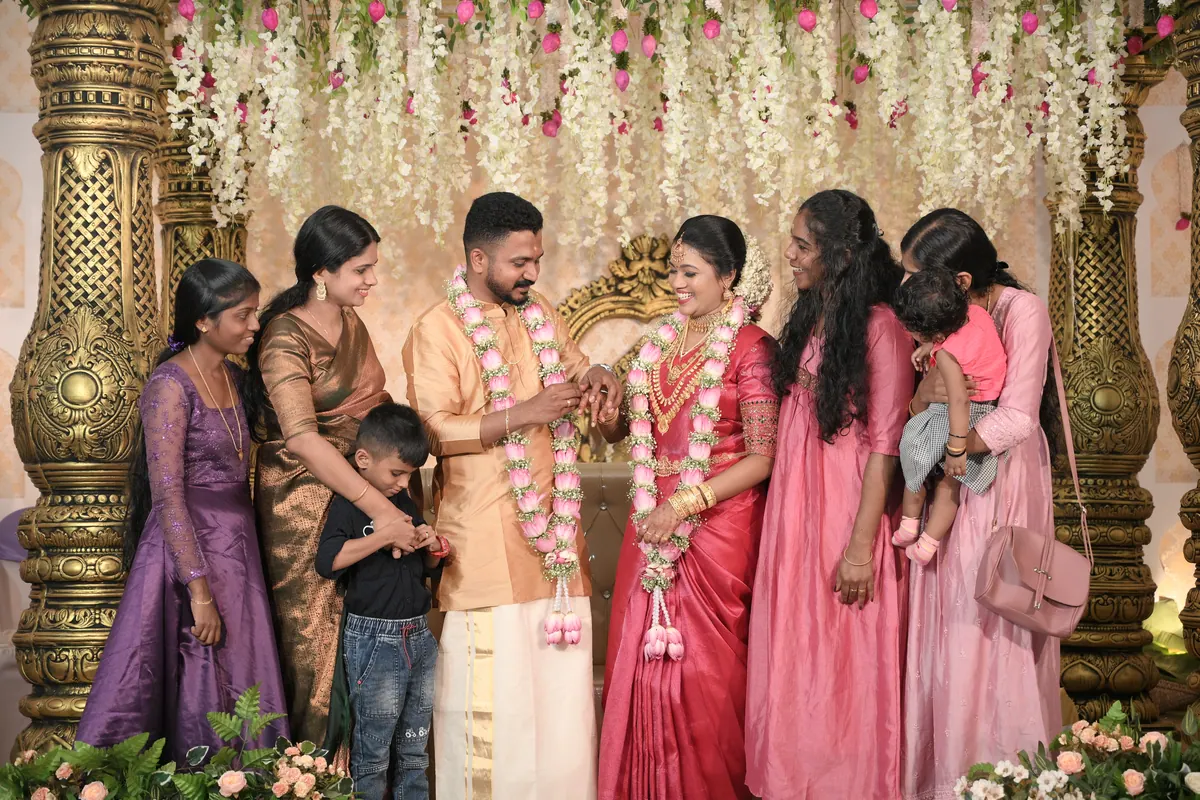
For the men, the same guide says the mundu “shouldn’t be styled folded, above the knees” (WeddingWire), and matching shirts are the easy win. Settle it in the family group early, before it gets renamed “Dress Code FINAL (actually final)” and someone still turns up in denim.
Guests and temple rules
At Guruvayur, men may wear only a plain white or cream dhoti, with no shirt, and women may wear a saree or a churidar (Kerala Tourism). Footwear stays outside too, so wear sandals you’ll recognise in a pile of two hundred nearly identical pairs.
The sadhya, and how to eat it
The sadhya is a vegetarian feast of up to 28 dishes on a banana leaf (Kerala Tourism), eaten with the right hand. The leaf’s tip points left, the food arrives in a set order, and nobody will hand you a fork, no matter how politely you ask.
| When | What’s served |
|---|---|
| First on the leaf | Banana chips, pickles and side dishes, laid out from the top left |
| First rice course | Parippu with ghee, then sambar |
| Second course | Kaalan or pulissery with the side dishes |
| Payasam | Ada pradhaman, palada or pal payasam, one or several |
| Last | Rice again with rasam and buttermilk |
Then the leaf gets folded, and here even Malayalis disagree. Onmanorama says fold it towards you after a happy occasion like a wedding (Onmanorama), while others say away. Copy the person next to you, and if they’re copying you, fold it in half and look confident.
Decorations: the mandapam and the lamp
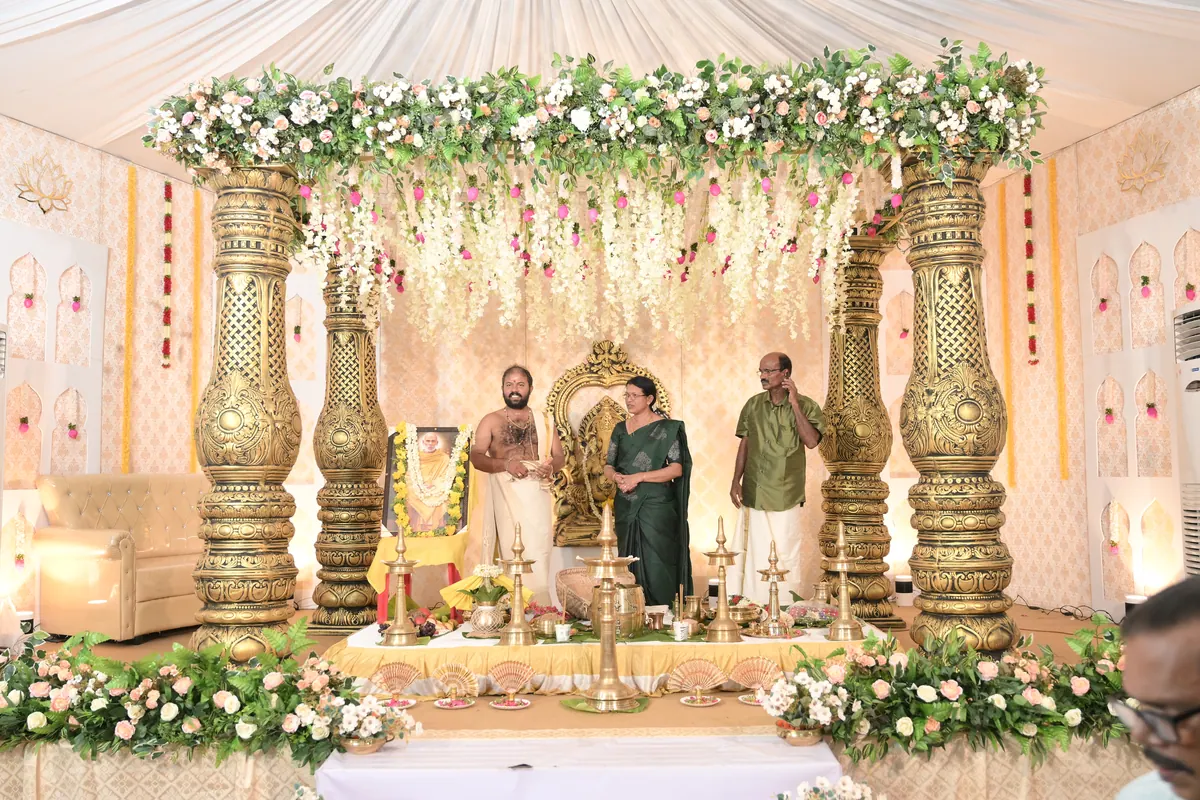
The couple sits on the kathir mandapam with lit lamps, and in front of them is the nirapara, a full measure of paddy topped with a coconut flower, beside betel leaves and plantains (IndiaVideo). Next to it sits the ashtamangalyam, a tray of eight auspicious items, and there’s “no one opinion” on which eight (Hindu Blog), so every family’s tray is correct and every other family’s is slightly wrong.
Coconut-leaf decor, the kuruthola, is back too: a Kochi green-wedding setup ran ₹15,000 to ₹75,000 in 2017 (The News Minute). The leaves wilt within days, so the artisans weave overnight (PARI). The only thing at the wedding that wilts faster is the groom in a silk shirt in April.
After the thali: grihapravesham
The bride enters the groom’s home carrying a lit nilavilakku, right foot first (WeddingBazaar). In a heavy silk saree, through a doorway, holding a flame, while thirty relatives film it on their phones, it’s quietly the hardest walk of the whole day.
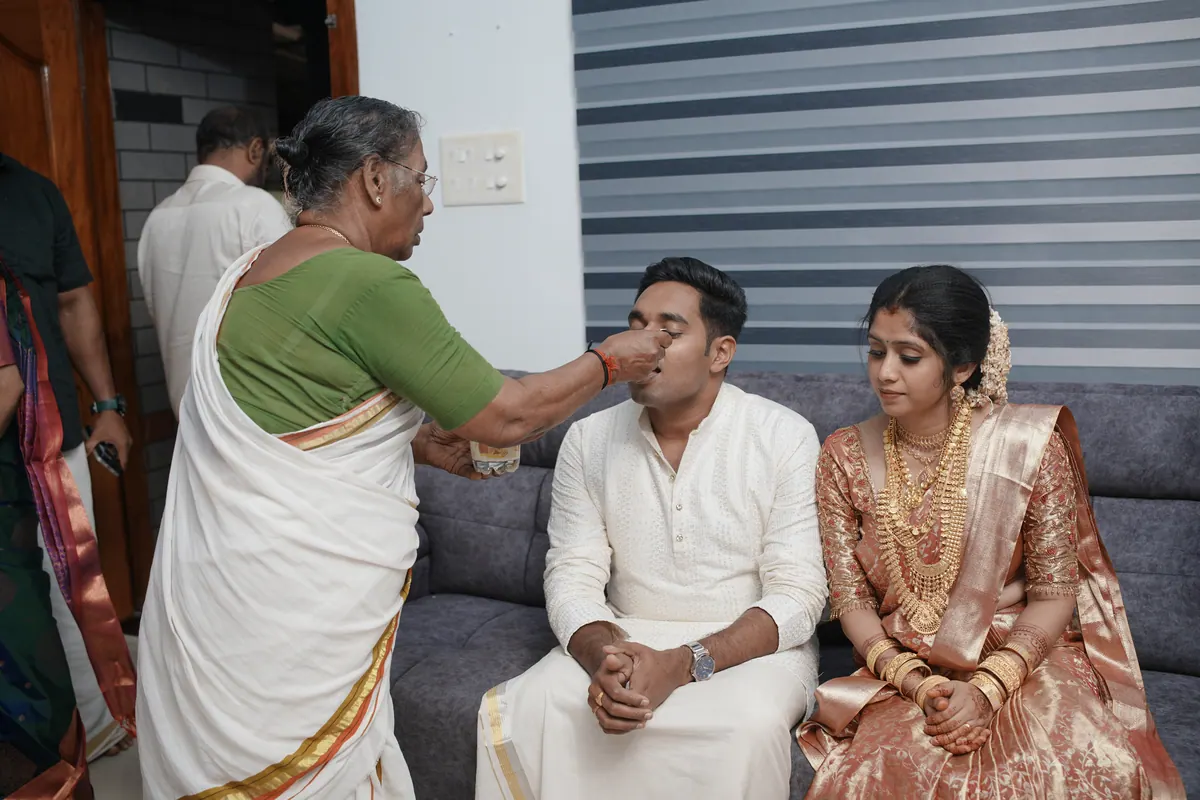
Inside, the family welcomes the couple with something sweet, often milk and banana shared from one cup (one family’s programme), the first thing the couple shares in the new house, a long way ahead of the TV remote. The kudivep, the bride’s first stay in the new home, follows, and the reception is usually the same evening. At Achu and Anjana’s, it meant a lilac gown and a black suit at sunset.
Photographing a Kerala Hindu wedding: what to plan for
One Kerala photographer told Scroll.in: “If you miss the moment, it’s gone” (Scroll.in). Temples add their own rules. On peak days at Guruvayur, only 24 people, photographers included, may stand near the mandapam (Deccan Chronicle), so the plan can’t include your favourite uncle, his new camera, and the nephew who’s “doing the reels.”
- The thali is seconds long. Ask the temple or the hall where cameras may stand before the day, not at the muhurtham.
- Do family photos before the sadhya. Once lunch is served, the stage empties faster than the payasam.
- Plan for two looks. The kasavu or silk for the ceremony, then the reception outfit, with a few portraits in each.
- You won’t wait months. Preview photos arrive within 24 hours, ready to post as a story, and the full edited set within 4 weeks of your selection.
I’ve photographed more than 1,000 weddings myself, and a Kerala Hindu wedding is the fastest of them all. The whole story happens in less time than the drive to the hall, so the photographer has to be ready before the drums start.
Questions couples ask
How long is a Kerala Hindu wedding ceremony?
Short. Photographers quoted by Scroll.in put a Kerala Hindu ceremony at 5 to 15 minutes, and many Nair weddings take about 15. Namboothiri and Tamil Brahmin weddings run longer, from a few hours to two days. The sadhya and the reception take the rest of the day.
What should I wear to a Kerala Hindu wedding as a guest?
Women usually wear a saree, a kasavu set saree or a churidar. Men wear a shirt and mundu, or formal shirt and trousers at a hall. At a temple wedding, skip jeans, and expect men to remove their shirts inside temples like Guruvayur.
What do cousins wear at a Kerala Hindu wedding?
Women cousins often wear kasavu sarees with a minimal gold border and matching blouses, or silk in one shared colour. Men cousins often match in kurta and mundu, or shirt and mundu. Agree the colours in the family group well before the wedding.
Who ties the thali at a Kerala Hindu wedding?
Usually the groom, at the muhurtham, to the sound of the kettimelam drums. In Namboothiri weddings the bride's father ties it, and in Tamil Brahmin weddings the groom's sister ties the remaining knots.
How many dishes are in a Kerala wedding sadhya?
Usually 24 to 28, served on a banana leaf. Kerala Tourism says a sadhya can have up to 28 dishes at a time. It's vegetarian and eaten with the right hand. The meal ends with one or more payasams.
Do Kerala Hindu weddings have haldi and mehendi?
Traditionally, no: they came from North Indian weddings. Many Kerala couples now add a haldi, a mehendi or a sangeet in the days before. Tell your photographer early, because each event is its own coverage.
Planning your Kerala Hindu wedding?
Tell us the venue, the muhurtham and the events, from the haldi to the reception, and we’ll plan the coverage around the thali. See how our Hindu wedding photography works. Marrying at the temple? The Guruvayur temple wedding guide is the best next read.
Co-founder and lead photographer at Hallowed Photography, Kochi. He started Hallowed in 2017, has photographed more than 1,000 weddings, and holds two international Fearless Photographers awards.